

Forging
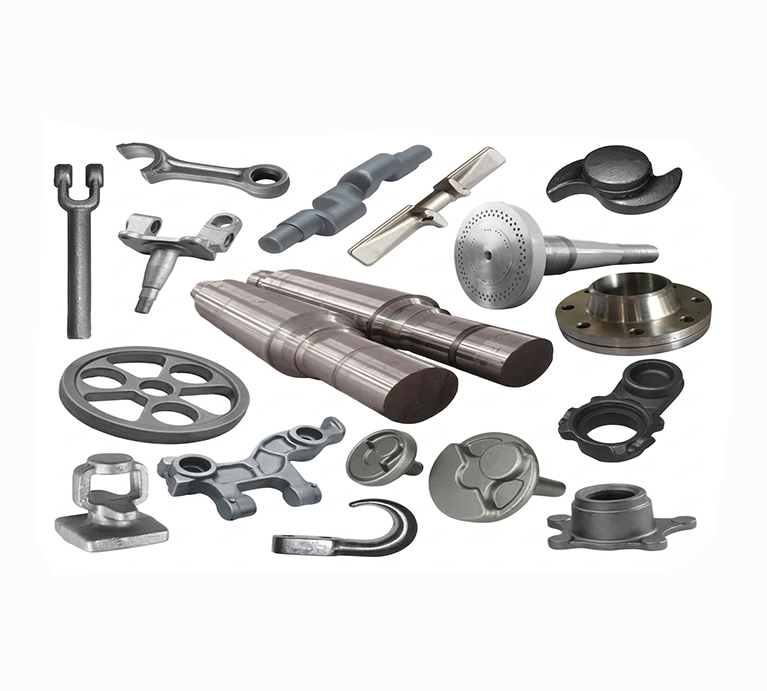
Forging is the process by which metal is heated and is shaped by plastic deformation by suitably applying compressive force. Usually the compressive force is in the form of hammer blows using a power hammer or a press.
Forging refines the grain structure and improves physical properties of the metal. Forgings are consistent from piece to piece, without any of the porosity, voids, inclusions and other defects. Thus, finishing operations such as machining do not expose voids, because there aren't any. Also coating operations such as plating or painting are straightforward due to a good surface, which needs very little preparation.
Common Forging Processes
Open Die Forgings / Hand Forgings
Open die forgings or hand forgings are made with repeated blows in an open die, where the operator manipulates the work piece in the die. The finished product is a rough approximation of the die. This is what a traditional blacksmith does, and is an old manufacturing process. We are backed up with Forging Hammers from 1 Ton to 5 Ton Capacity and Presses of 4400 T and 1600 T.
Impression Die Forgings / Precision Forgings
Impression die forgings and precision forgings are further refinements of the blocker forgings. The finished part more closely resembles the die impression. We have pneumatic hammers for doing the Impression Die Forgings.
Press Forgings
Press forging uses a slow squeezing action of a press to transfer a great amount of compressive force to the work piece. Unlike an open-die forging where multiple blows transfer the compressive energy to the outside of the product, press forging transfers the force uniformly to the bulk of the material. This results in uniform material properties and is necessary for large weight forgings. Parts made with this process can be quite large — as much as 125 kg (260 lb) and 3m (10 feet) long.
Upset Forgings
Upset forging increases cross-section by compressing the length. This is used in making heads on bolts and fasteners, valves and other similar parts. We are backed up with Forging Upsetters from 1.5 inch to 15 inch diameter.
Seamless Rolled Ring Forgings
Seamless rolled ring forging is typically performed by punching a hole in a thick, round piece of metal (creating a donut shape), and then rolling the donut into a thin ring. We have 4 Ring Rolling Mills equipped with Schuler presses with capacity to produce rings up to 500mm (20 inch) Outer Dia and up to 25 KG (55 lbs) in weight. We can also make Contoured Rings so as to reduce the machining allowances to a minimum and make them very similar to the final shapes.
Swaging
Swaging — a tube or rod is forced inside a die and the diameter is reduced as the cylindrical object is fed. The die hammers the diameter and causes the metal to flow inward, causing the outer diameter of the tube or the rod to take the shape of the die.
Aluminium Forgings
Aluminium drop forged pieces will always offer the most economic solution when, in addition to light weight, such factors as strength, appearance and recycling potential are also important. We specialize in aluminium drop forged pieces. We can employ any aluminium alloy (ex – HE12, HE15, HE30, 6061, 6063 and others) according to the demands of the individual assignment. We carry out production in small, medium and large batch quantities with an individual weight of up to 15 kilograms. We do close die forgings using the most modern Friction Screw Presses and Drop Hammers.